Valmiki Ramayana Balkanda - The Adi Kavya Simplified.


Among the many noble characters of the Śrīmad Vālmīki Rāmāyaṇa, the story of Jatayu shines as an example of selfless duty, sacrifice, and unwavering devotion to Dharma.
Though born in the form of a vulture, Jatayu’s heart was pure, noble, and deeply aligned with righteousness.
Who Was Jatayu?
Jatayu was the son of Aruna, who was the charioteer of Surya (the sun god).
He was a powerful divine bird and a close associate of King Dasharatha, the father of Lord Rama.
Being related to Garuda, the eternal carrier of Lord Vishnu, Jatayu carried the spirit of protection and service.
In the later years of his life, although aged and physically weakened, Jatayu remained ever alert in upholding the principles of Dharma.
(Valmiki Ramayana, Aranya Kanda, Sarga 14 and Sarga 50 mention Aruna and Garuda relation.)
The Abduction of Sita and Jatayu’s Intervention
During Rama’s exile in the forest, Ravana deceitfully abducted Sita Devi while Rama and Lakshmana were momentarily away.
Jatayu, witnessing Ravana forcefully carrying Sita in his celestial chariot, could not stand by silently.
Realizing the gravity of the moment, he immediately challenged Ravana to protect the honor of Sita.
Sita Devi herself, while being carried away, cried out for help, calling upon the trees, rivers, mountains, and beings of the forest — and it was then that Jatayu appeared to defend her.
(Valmiki Ramayana, Aranya Kanda, Sarga 50–51)
Jatayu’s Battle Against Ravana
Despite his advanced age, Jatayu engaged Ravana in a fierce battle.
He attacked Ravana’s chariot, broke its flag, destroyed its canopy, killed Ravana’s horses, and even shattered his bow.
For a time, Jatayu successfully impeded Ravana’s movement.However, Ravana, enraged and using a powerful sword, eventually severed both the wings of Jatayu, causing him to fall gravely wounded to the ground.
The Ramayana describes this heroic moment beautifully:
“तं दृष्ट्वा जातया च गतायुषं तमापतत्पततां वरः।
स धर्मात्मा सत्यसंधश्च तं शुश्राव राघवः॥”
(Valmiki Ramayana, Aranya Kanda, Sarga 67, Shloka 22)
Translation:
“Seeing Jatayu, aged and lifeless, fallen like the best among birds, Rama — the embodiment of Dharma and truth — listened to his final words.”
Why Did Jatayu Sacrifice His Life?
Jatayu’s courageous act was not driven by mere impulse but by profound spiritual and moral principles.
Deeper Significance:
- Protection of Dharma: Jatayu knew that protecting a helpless woman, especially the consort of the Lord Himself, was his highest duty.
- Service to Lord Rama: As a friend of Dasharatha and a devotee of Rama, Jatayu saw Rama’s mission as his own.
- Selfless Sacrifice: Aware of his frailty against Ravana’s strength, Jatayu still chose to fight, embodying that Dharma must be upheld even against insurmountable odds.
- Divine Fulfillment: His life found complete fulfillment by offering it in the Lord’s service.
Jatayu’s Final Moments and Liberation
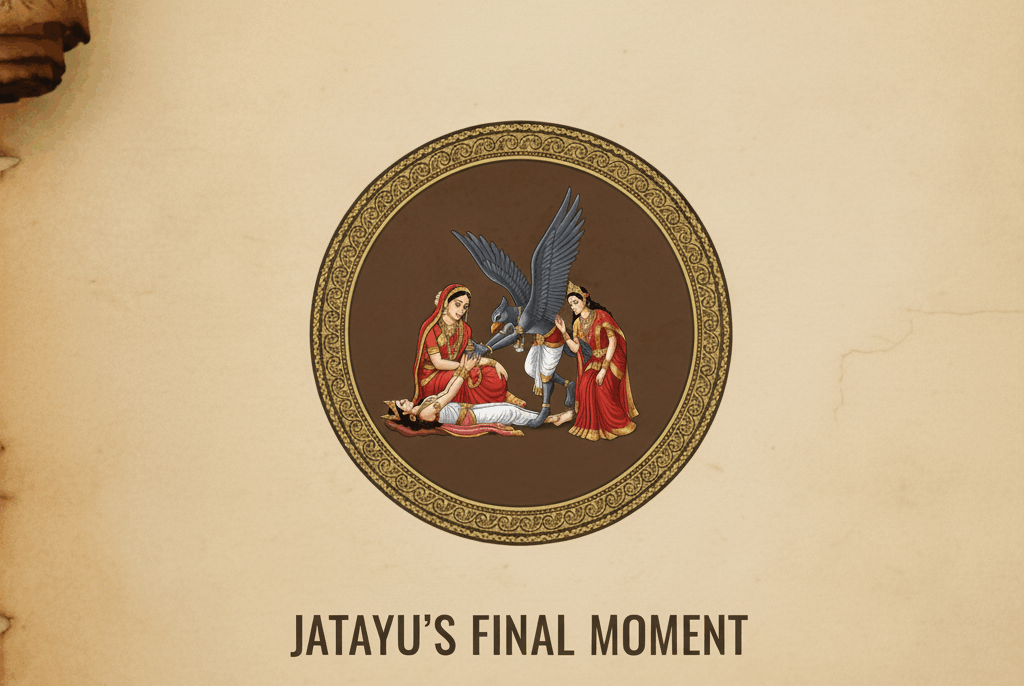
After Ravana had escaped with Sita, the mortally wounded Jatayu lay breathing his last.Lord Rama and Lakshmana, while searching for Sita, encountered him.
Jatayu, with his remaining strength, narrated the details of Sita’s abduction to Rama — fulfilling his final duty.
Rama, deeply moved by Jatayu’s sacrifice, embraced him, treated him with utmost respect, and personally performed his last rites — an honor rarely bestowed.
Jatayu’s soul attained moksha (liberation) by the grace and touch of Lord Rama Himself.
(Valmiki Ramayana, Aranya Kanda, Sarga 68)
The Legacy of Jatayu
Jatayu’s sacrifice stands as an eternal reminder that Dharma is above life itself.He showed that true heroism is not about victory but about fearlessly upholding righteousness — even if it means giving up one’s own life.
In Kerala today, the Jatayu Earth’s Center commemorates his valor, honoring the great service he rendered to Lord Rama and Sita Devi.
Frequently Asked Questions (FAQs)
Q1. Was Jatayu a demigod or an ordinary bird?
Jatayu was a divine bird — son of Aruna and related to Garuda — blessed with exceptional intelligence, strength, and virtue.
Q2. Could Jatayu have survived if Rama arrived earlier?
Jatayu’s destiny was to sacrifice himself in service of Dharma and fulfill the role of informing Rama about Sita’s abduction. His glorious end was part of the divine plan.
Q3. Why did Lord Rama perform Jatayu’s last rites?
Recognizing Jatayu’s selfless sacrifice for Dharma and love for Sita Devi, Rama honored him as He would honor the greatest of sages and heroes.
Conclusion
The story of Jatayu teaches that courage, sacrifice, and devotion are the true measures of greatness.
Regardless of strength, age, or circumstance, those who uphold Dharma earn eternal glory.
Jatayu’s life and death remain a shining example of what it means to live — and die — in the service of righteousness and God.
Discover More Eternal Wisdom
To explore more such divine histories and insights, we invite you to experience the Ramayana Book, a verse-by-verse exposition rooted in authentic Sanskrit scriptures and timeless commentaries.
This sacred work offers deep reflections on Dharma, Bhakti, and inner transformation for today’s seekers.
👉 Access the Ramayana Book here.